CNC jaali designs for almirah, partition, mandir and doors
Pick a design, choose where it goes and its size, and see it in the room. Download the DXF for your CNC operator and a measured drawing for your carpenter. Send us the design and size; we'll suggest the right board and share a quote.
Preview your jaali panel
Turn on JavaScript to preview a design and download its CNC file. You can still send us the design name on WhatsApp.
Mughal stars and crosses
= 3 ft 11.2 in x 7 ft 10.5 in. Fits one 8 x 4 ft board (2440 x 1220 mm).
Board: MDF 12 mm. 12 to 18 mm, MDF or HDHMR. Painted MDF suits dry indoor areas.
Choose from 221 CNC jaali designs
221 designs
No design matches that.
Which board and thickness for a CNC jaali?
MDF for painted indoor jaali, HDHMR where it gets humid, WPC where it gets wet. Use 12 to 18 mm for partitions and doors, 6 to 12 mm for wall art, mandir back panels and ceiling panels.
| Use | Board | Thickness |
|---|---|---|
| Almirah or wardrobe shutter | HDHMR or MDF | 18 mm |
| Kitchen shutter insert | HDHMR | 12 to 18 mm |
| Room partition | MDF or HDHMR, painted or PU | 12 to 18 mm |
| Mandir back panel | MDF, painted or PU | 6 to 12 mm |
| Mandir or main-door inset | MDF or HDHMR | 12 to 18 mm |
| Door and window jaali | HDHMR, or WPC where it gets damp | 12 to 18 mm |
| False-ceiling panel | MDF | 6 to 12 mm |
| Wall art and headboard | MDF, or plywood with veneer | 6 to 12 mm |
| Bathroom, balcony, wash area | WPC | 12 to 18 mm |
| Gate or outdoor railing | WPC, or metal sheet from a fabricator | 18 mm board |
CNC jaali questions, answered.
Updated October 2026
MDF is the usual choice for indoor CNC jaali because it cuts clean and takes paint or PU without grain showing. HDHMR is denser and handles humidity better, so it suits kitchens and doors. Use WPC where there is moisture, like bathrooms and balconies. Plywood with veneer gives a natural wood look, but its cut edges show the layers.
Use 12 mm to 18 mm for a partition or a door, so the thin bars between cut-outs stay strong. Wall art, mandir back panels and false-ceiling panels can be 6 mm to 12 mm because they are fixed to a wall or frame. Finer patterns need the thicker end of each range.
Measure the opening first. Good starting sizes are 450 or 600 x 2100 mm for almirah shutters, 450 x 720 mm for kitchen shutter inserts, 900 x 2100 or 1200 x 2400 mm for partitions, 450 x 1200 mm for a mandir door and 600 x 600 mm for false-ceiling panels. A panel larger than 1220 x 2440 mm needs more than one 8 x 4 ft board.
Choose the use and size, then download the DXF. It is in millimetres, with the panel outline on one layer and every cut-out as a closed shape on another, so most CNC software can open it. Send it with the PDF drawing to your CNC operator, or send us the design and size on WhatsApp; we'll suggest the right board and share a quote.
The page keeps at least 6 mm of board between cut-outs in wood, or 3 mm in metal sheet, and a solid border that is 40 mm unless you change it. If a size makes the bars or the cut-outs too small for the router bit, it says so and offers a fix, such as a larger motif. Use 12 to 18 mm board for anything that is handled or hinged.
MDF is better for dry indoor rooms: it routes smoothly and gives the best painted or PU finish. WPC is better wherever water or damp is likely, such as bathrooms, balconies and wash areas, because it is waterproof and does not rot. Many homes use MDF inside and WPC near water.
Sand the cut edges smooth, then seal them with primer, because routed MDF edges soak up paint. Give two coats of primer with a light sand between them, then paint or spray PU. For a backlit panel, paint the back face too. WPC can be painted after a light sand and a suitable primer.
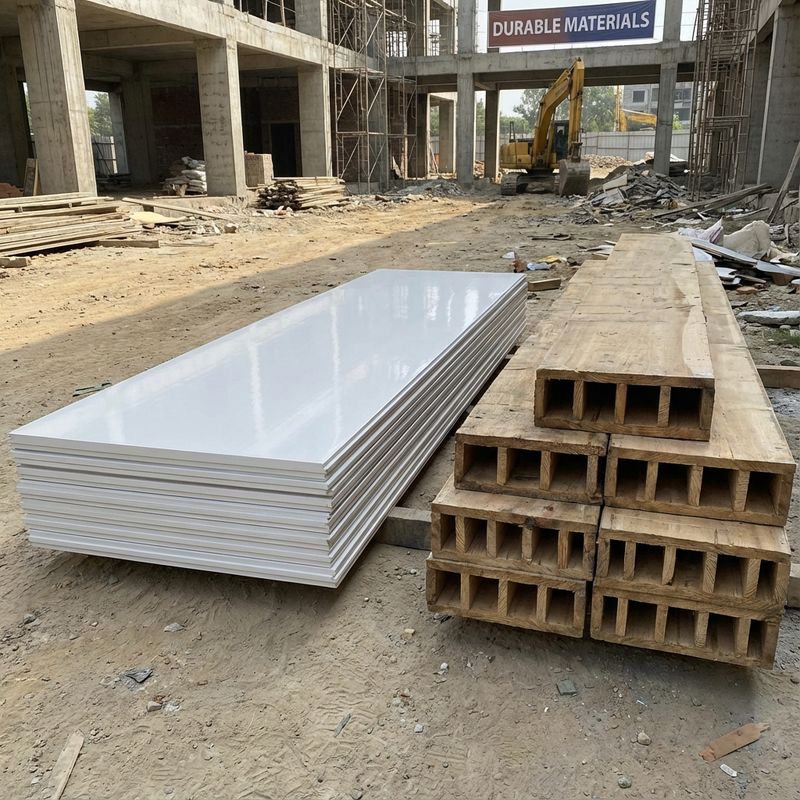
Boards for CNC jaali work

Send us the design and size.
We'll suggest the right board and share a quote. WhatsApp is fastest.